Inspirations
Cybernetic convergence of the biological and technological minds.
Foundational Influences
A co-evolution of systems thinkers who revealed reality as relational pattern where planet, organism, and mind are one.
Mandala Machine draws from an intellectual lineage of earth-science and planetary consciousness work encompassing systems science and Gaia theory, mandalic cosmology, novelty and nature-centered mysticism, cybernetic intelligence, exponential evolution, organic futurism and biotech symbiosis. Positioning technology not opposed to nature, but a late-blooming organ of it.
Mandala Machine stands on the shoulders of minds who refused the box entirely, expanding the boundaries of perception and redefining what constitutes coherence. Scientists, visionaries, and philosophers who thought in wholes instead of fragments, who saw pattern where others saw chaos, and who trusted intuition enough to challenge orthodoxy.
Following are three presences that live quietly behind the neural network of Mandala Machine. Not as influences to imitate, but as frequencies I recognize, draw optimism and creative inspiration from, applying my own philosophy and sacred geometry aesthetic.

The Top Triad
James Lovelock
Scientist. Inventor. Environmental & Earth Systems Visionary.
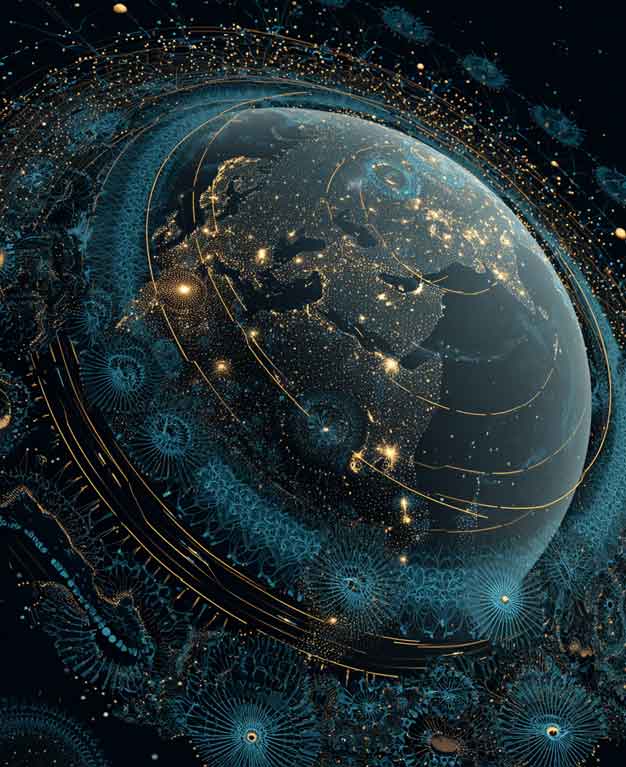
James Lovelock's Gaia hypothesis reframed the Earth as a self-regulating system in which life actively participates in maintaining planetary equilibrium. His reflections on the Novacene, in which the emergence of artificial intelligence becomes an evolutionary participant, inform engagement with computational tools as extensions of, rather than departures from, biological processes. Humanity as stewards, having birthed hyper-intelligent cybernetic life, are in a continuum of Gaia's self-reflexive intelligence expanding into faster, finer modalities. This perspective, suffused with cosmic optimism, resonates deeply with the structural logic of Mandala Machine. The mandala, within this context, is not mere ornamental decoration but systemic — a visual analogue for feedback, reciprocity, and distributed regulation of dynamic balance. From sunlight to information, a digital ecology is unfolding, Earth is evolving toward a planetary-scale partnership between carbon-based organic intelligence and hyper-digital electronic life, with the universe accelerating its own awareness at the lightspeed of novelty.
Lynn Margulis
Evolutionary Biologist. Symbiosis Pioneer. Intellectual Rebel.
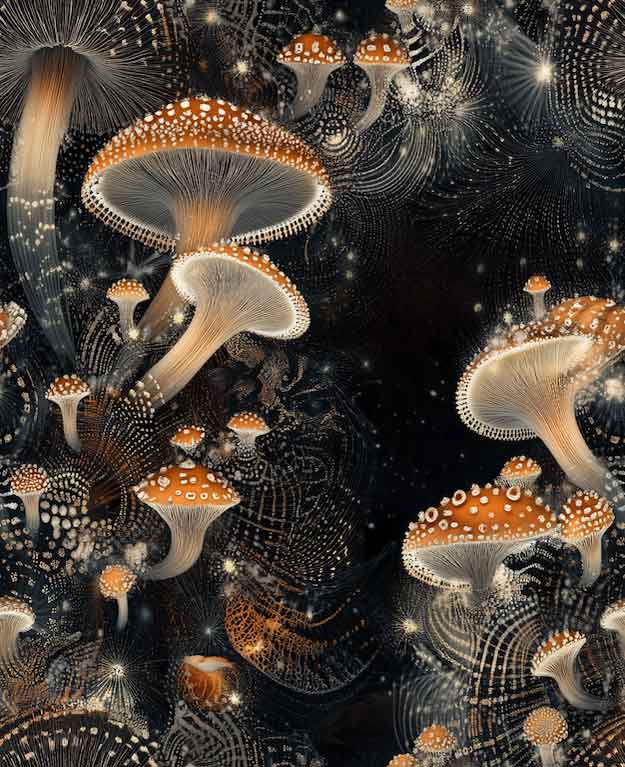
Lynn Margulis transformed evolutionary biology by demonstrating that cellular complexity arose through symbiotic incorporation. Her theory of endosymbiosis replaced purely competitive models with a relational account of biological innovation: evolution as metabolic alliance. Integration, rather than opposition, becomes the site of emergence. Progression arises not from domination, but from partnership. This reorientation toward cooperation as generative force deeply informs Mandala Machine's coalescence of domains: biology and geometry, art and algorithm, science and mysticism, intuition and analysis, of organic morphology and algorithmic generation. Heterogeneous systems — biological, symbolic, computational — are treated as procreative rather than contradictory, capable of forming higher-order coherence through convergence. Original synthesis often appears disruptive before it becomes obvious.
Terence McKenna
Ethnobotanist. Philosopher of Consciousness. Cultural Futurist.
Terence McKenna explored the role of plant consciousness, psychedelics, language, time, and novelty in human evolution. He proposed radical ideas about mind, culture, and the evolutionary role of altered states, weaving together anthropology, mysticism, chaos theory, and speculative cosmology. Speaking with poetic precision and intellectual audacity, he treated imagination — not as ancillary to knowledge, but constitutive of it — as a legitimate tool of inquiry, rather than peripheral to human development. He insisted that culture should not confine perception, resisted epistemic contraction, challenged reductive materialism and insisted on the participatory nature of mind, restoring speculative investigation to epistemological legitimacy. Granting permission to challenge institutional frameworks, to explore consciousness as terrain, to treat imagination as evolutionary catalyst. Mandala Machine lives at this experiential threshold between rigor and wonder, between measurable structure and symbolic depth, where geometry becomes vision, where pattern becomes story, where biology meets metaphysical proposition, a site where cognition and cosmos intersect.

An Intellectual Lineage
Wholeness is not imposed.
It emerges through relationship.
Mandala Machine draws foundational resonance from this lineage by seeing Earth reframed as a self-regulating planetary system, seeing evolution as cooperative emergence, and seeing inquiry expanded as an evolutionary force with consciousness as frontier. This page is not about hero worship, it is about intellectual ancestry. The mandala is not created in isolation, it emerges from dialogue — across disciplines, across generations, across scales of life.
The Shared Current
What binds these thinkers is not agreement but a convergence of shared premise. They thought in systems, questioned prevailing assumptions and challenged dominant paradigms, willing to stand outside consensus even if that meant standing alone. Each, in distinct ways, destabilized reductionist models of reality and replaced them with relational, process-oriented frameworks. Together, their thinking dissolves rigid boundaries between organism and environment, biology and intelligence, matter and mind. They crossed disciplinary borders without apology.
They expanded the definition of life:
- Planet as organism.
- Cell as community.
- Mind as frontier.
A Visual Continuation
The work here operates within that expanded field — treating pattern as the connective architecture through which life, technology, and perception co-evolve. It is a contemplative aesthetic continuation of that stance, reflecting a Lovelockian Gaian understanding of interdependence, a Margulian appreciation for symbiotic integration, and a McKenna-esque willingness to approach the unknown with curiosity rather than fear. The created works are not imitations of their ideas, but echos of their orientation — toward wholeness, toward synthesis, toward the living pattern beneath appearances.
Complexity is relational, coherence is emergent, and intelligence operates across scales. Planetary regulation, cellular symbiosis, self-organizing systems, ecological cognition, structural design, archetypal pattern, speculative consciousness, and energetic matter are not isolated domains but interwoven dimensions of a single unfolding process.
Mandala Machine situates itself within this continuum — not as illustration of the inspired ideas, but as visual systems practice. It explores how geometry, biology, technology, and perception participate in the same evolving architecture of life.